Black-Capped Conure: Complete 2026 Care & Price Guide
Updated October 20, 2026
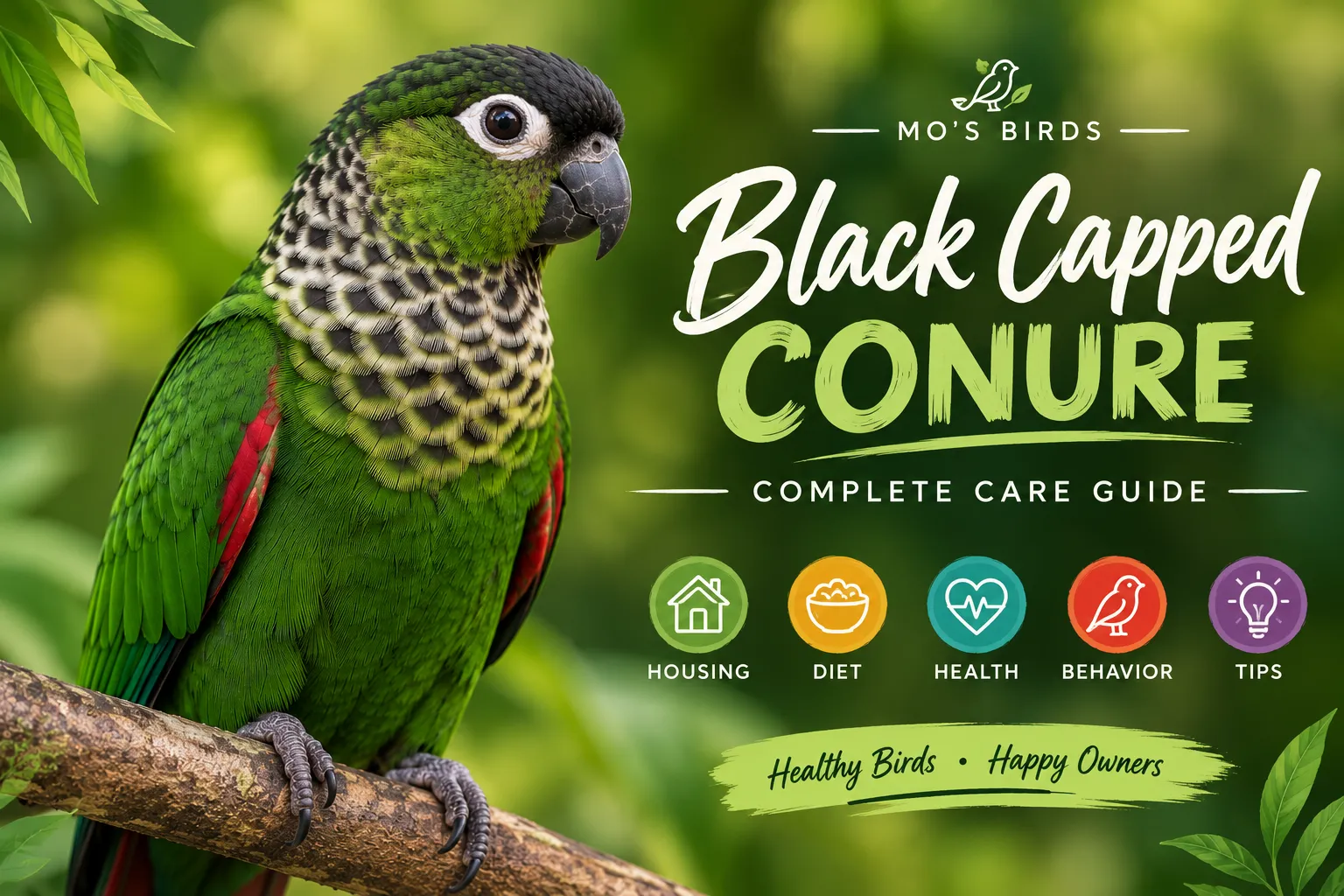
If you have fallen for those big white eye-rings and that scaly brown bib, you are already halfway to bringing home a black-capped conure. This small South American parrot is quieter than a sun conure, just as playful as a green-cheek, and marked with a look no other species quite has.
This guide covers everything a first-time or experienced owner needs before buying one, including appearance, temperament, lifespan, diet, housing, and what a black-capped conure for sale typically costs.
What Is a Black-Capped Conure?
The black-capped conure (Pyrrhura rupicola) is a small parrot native to the humid lowland forests of Peru, Bolivia, and western Brazil. In the wild, these birds travel in noisy little flocks through the forest canopy, feeding on fruit and roosting together at night.
According to the World Parrot Trust, the species is listed under CITES Appendix II and classified as IUCN Least Concern, with a wild population estimated between 100,000 and 500,000 birds that is currently considered stable.
What sets this conure apart visually is its head. Instead of the solid green cap most Pyrrhura conures wear, it has a dark blackish-brown cap that extends down the nape, framed by a bold white bare eye-ring. Its chest carries a scaly, scalloped pattern in dark brown feathers narrowly edged in near-white, giving a necklace-like look that fades into green. The wings are green with a vivid red patch on the primary coverts, there is a small patch of deep red on the lower belly, and the tail is green on top with a maroon-red underside.
Black-Capped Conure Temperament and Personality
Ask any owner and they will tell you the same thing: this bird has a big personality packed into a small body. It is curious, food-motivated, and quick to bond with its primary caregiver. Many owners describe their pet as a “velcro bird” that wants to ride around on a shoulder or sit nearby while you work.
Compared to other conures, this species tends to sit on the calmer end of the volume spectrum. It is not a silent bird by any means, but it lacks the piercing scream of a sun or jenday conure, which makes it a realistic option for apartments and shared housing, provided neighbors can tolerate a chatty pet bird.
Early, consistent handling matters. A hand-fed baby that gets daily attention from a young age typically grows into a confident, affectionate adult. One that is left in its cage without interaction can become nippy or reclusive, just like any parrot species.
Size, Lifespan, and Physical Traits
A full-grown black-capped conure measures about 9.5 to 10 inches from head to tail and weighs around 70 grams, putting it in the same general size class as a green-cheek conure. With attentive care, a quality diet, and regular veterinary checkups, this bird can live 20 to 30 years, so adopting one is a decades-long commitment, not a short-term pet purchase.
-
Length: roughly 9.5–10 inches, tail included
-
Weight: approximately 70 grams
-
Lifespan: 20–30 years with proper care
-
Color: the wild-type coloring described above is by far the most common form in US aviculture
Black-Capped Conure Diet and Nutrition
This small parrot needs more than a bowl of seed. Seed-only diets are a leading cause of fatty liver disease and nutritional deficiencies in small parrots, so the base of the diet should be a high-quality formulated pellet, supplemented daily with fresh vegetables and a smaller portion of fruit.
-
Pellets: 60–70% of daily intake, as the nutritional foundation
-
Fresh vegetables: leafy greens, bell pepper, carrot, and squash offered daily
-
Fruit: small amounts of apple, berries, mango, or papaya as a treat
-
Healthy extras: sprouted legumes, cooked whole grains, and an occasional nut for enrichment
-
Avoid entirely: avocado, chocolate, caffeine, onion, and anything high in salt or sugar
Fresh water should be changed daily, and food dishes cleaned regularly to prevent bacterial growth. If you are transitioning a seed-dependent bird to pellets, expect the process to take a few weeks of patient, gradual mixing rather than an overnight swap.
Housing and Cage Setup
Because it is an active, acrobatic little parrot, this species needs a cage no smaller than 24 x 24 x 24 inches, with bar spacing of around half an inch so it cannot squeeze through or get a wing stuck. Bigger is always better if space allows, especially for a bird that will spend two to three decades in your home.
Fill the cage with two or three perches of different diameters and textures to keep foot muscles healthy, along with foraging toys, shreddable wood, and rotating chew toys to satisfy its strong beak. Out-of-cage time matters just as much as the cage itself; plan for at least two to three hours of supervised time outside the cage every day.
Training and Enrichment
A bored bird is far more likely to develop problem behaviors like screaming, feather plucking, or nipping, so enrichment should be part of the daily routine, not an afterthought. Rotating foraging toys, puzzle feeders, and short training sessions keep that sharp little brain occupied.
Positive-reinforcement training works well with this species. Short, five-minute sessions focused on step-up, target training, or simple tricks build trust quickly, and most owners find their bird picks up new behaviors faster than expected once a consistent reward routine is in place.
Common Health Issues to Watch For
Like most small parrots, this species is generally hardy when kept on a proper diet, but a few issues are worth watching for. Respiratory infections, feather plucking from boredom or stress, and overgrown beaks or nails from a cage with too few varied perches are the most common complaints owners report.
An annual wellness exam with an avian veterinarian, rather than a general small-animal vet, is the single best way to catch problems early. Parrots instinctively hide illness, so subtle changes in droppings, appetite, or activity level are often the first real warning sign.
Black-Capped Conure vs. Green-Cheek Conure
Because the two birds are close in size, shoppers often cross-compare this species with a green-cheek before deciding. Both make excellent apartment pets and share a similar moderate noise level, so the real differences come down to appearance, availability, and budget.
A green-cheek wears a mostly green head with a maroon tail, while this species stands out with its dark cap, white eye-ring, and scaly brown chest. Green-cheeks are also bred far more widely, which usually keeps their price lower and makes finding one easier than finding a black-capped conure for sale in a given area.
Black-Capped Conure Price: What to Expect
Pricing typically runs higher than common species like the green-cheek, simply because fewer breeders work with this bird. Expect a hand-raised, weaned baby from a reputable breeder to fall in a noticeably higher range than a green-cheek, with exact cost depending on the breeder’s location, hand-feeding process, and DNA testing.
Always buy a black-capped conure for sale from a breeder who can show proof of hand-feeding, a weaning timeline, and ideally a DNA sexing certificate. A bird pulled too early or weaned improperly is far more likely to develop behavioral issues down the road, no matter how low the asking price looks.
| Conure Species | Typical Adult Size | Noise Level | Relative Price Range |
|---|---|---|---|
| Green-Cheek Conure | ~10 in | Low-Moderate | Lower |
| Black-Capped Conure | ~9.5–10 in | Low-Moderate | Moderate-High |
| Sun Conure | ~12 in | Very High | Moderate |
| Jenday Conure | ~11–12 in | High | Moderate |
Daily and Weekly Care Checklist
Consistency is what keeps this bird healthy and well-adjusted. A simple daily and weekly routine covers most of what the species needs.
-
Fresh food and water every day, with dishes washed daily
-
At least two to three hours of supervised out-of-cage time daily
-
Rotating toys weekly to prevent boredom
-
A full cage deep-clean once a week
-
Annual wellness checkups with an avian veterinarian
Is a Black-Capped Conure Right for You?
This bird suits someone who wants a small, intelligent parrot with real personality but does not want the ear-splitting volume of a sun conure. It is a strong match for a first-time conure owner who has done their homework on diet, housing, and the multi-decade commitment involved.
It is a poor match for anyone who travels constantly, cannot offer daily out-of-cage interaction, or lives somewhere that cannot tolerate even moderate chirping and chattering throughout the day.
Frequently Asked Questions
How big does a black-capped conure get? Adults reach about 9.5 to 10 inches long and weigh roughly 70 grams, similar in size to a green-cheek conure.
How long does a black-capped conure live? With a proper diet, a clean environment, and regular vet care, this bird can live 20 to 30 years.
Are black-capped conures loud? They are more vocal than a budgie but considerably quieter than a sun or jenday conure, making them a reasonable choice for apartment living.
Do black-capped conures talk? They can learn a handful of words and sounds, though like most conures they are better known for personality and playfulness than for a large vocabulary.
A black-capped conure brings together an unusual look, a manageable size, and a calmer voice than most conures, all wrapped up in a bird that can be part of the family for decades.
Morphnests hand-raises black-capped conures with careful weaning and nationwide safe bird shipping, so your new companion arrives healthy and ready to bond. See current black-capped conures for sale and pricing, and reach out with any questions about bringing one home.