How to Teach a Parrot to Talk: Best 2026 Step-by-Step Guide
Updated November 4, 2026
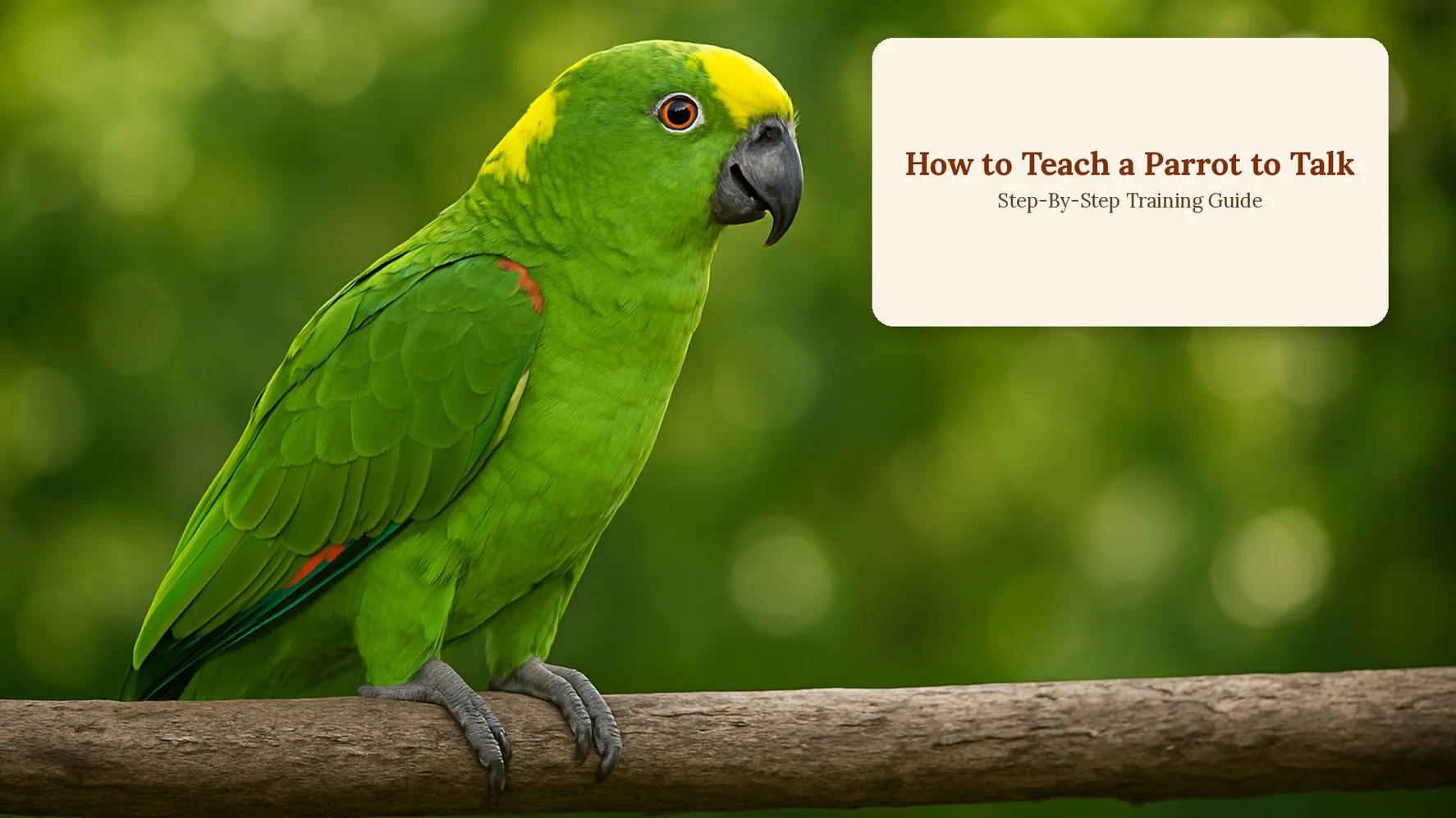
Few things delight a new owner more than hearing their bird say its first real word. If you are wondering how to teach a parrot to talk, the truth is that speech is a trainable skill built on repetition, timing, and a bird with the right natural aptitude — not luck. This guide walks through the exact step-by-step method breeders and avian trainers use, the best starter words, a realistic training schedule, and the mistakes that quietly stall most owners’ progress. Whether you just brought home a hand-raised baby or you’ve had your parrot for years without a single word, the same core method applies.
Table of Contents
Which Parrots Learn to Talk Best
Before you start teaching, it helps to know whether your species is naturally inclined toward speech. African greys, Amazon parrots, and cockatoos consistently rank among the clearest and most prolific talkers, while budgies and Quaker parrots can build surprisingly large vocabularies for their size. Macaws, Pionus, and Senegal parrots tend to speak less often, even with consistent training, though individual birds vary widely. For a full breakdown of which species talk best and why, see our ranked guide to the best talking parrots.
What Affects How Fast a Parrot Learns to Talk
Three factors matter more than any training trick: species, age, and how much direct interaction the bird gets each day. Younger birds generally pick up speech faster than adults, but older parrots can absolutely still learn. A bird that spends more waking hours near its owner, hearing consistent words, will almost always out-talk one that is trained for a few rushed minutes a day. Confidence matters too — a stressed or under-socialized bird rarely talks until it feels secure in its environment.
Household routine plays a bigger role than most owners expect. Parrots are highly social flock animals in the wild, and in a home they treat the people around them as their flock. A bird that hears the same handful of words tied to the same daily events — morning greetings, meal time, bedtime — builds associations far faster than one that only hears speech during dedicated lesson time. Background television or radio chatter can actually work against you here, since it buries the specific word you want your bird to isolate and repeat.
Sex and individual temperament matter too. In several talking species, males are statistically a bit more likely to develop a larger vocabulary than females, though plenty of female parrots are excellent talkers. Ultimately, personality varies as much between individual birds of the same species as it does between species, so treat every training timeline as a starting expectation rather than a guarantee.
How to Teach a Parrot to Talk: Step-by-Step
This is the core method for teaching a parrot to talk, broken into stages so you can see exactly where your bird is in the process.
-
Pick one short word first. Choose something simple and distinct, like “hi,” “bye-bye,” or the bird’s own name. Avoid starting with long phrases.
-
Say it the same way every time. Face your bird, use the same tone, pitch, and emphasis on every repetition. Parrots learn the pattern of a sound, so consistency speeds things up far more than volume or enthusiasm alone.
-
Pair the word with a meaningful moment. Say “hi” every time you walk into the room, or “step up” every time you offer your hand. Context-linked words are often learned faster than random repetition.
-
Reward any response, not just perfect speech. Early on, reward the bird simply for looking at you or vocalizing at all. Gradually raise the bar so only closer approximations of the word earn the treat.
-
Use a training-only treat. A small piece of nut, seed, or fruit that your bird only gets during talking practice stays far more motivating than treats it receives throughout the day.
-
Keep sessions short and frequent. Five to six repetitions, two or three times a day, outperforms one long session. Birds lose focus quickly once a session drags on.
-
Stop before your bird loses interest. If your parrot turns away, gets fidgety, or stops responding to treats, end the session. Pushing through disinterest teaches a bird to dread training rather than enjoy it.
Best Words and Phrases to Start With
Short, high-contrast sounds are easiest for a parrot’s vocal tract to approximate early on. Good starter words include:
-
“Hi” or “hello”
-
“Bye-bye”
-
The bird’s own name
-
“Step up” (paired with the step-up cue itself)
-
“Good bird” or “pretty bird”
-
A one-syllable whistle or simple sound effect
Once your bird reliably produces one or two words, you can build toward short phrases by linking a learned word to a new one, the same way it originally linked a word to a routine or a treat.
Building From Single Words to Short Phrases
Once a first word is solid, resist the urge to jump straight to full sentences. Add one new element at a time. If your bird says “hi” reliably, start pairing it with a name: “hi, pretty bird.” Once that combination is consistent, you can introduce a third element. Each new piece should be trained the same way the first word was — same tone, same context, same reward structure — rather than treated as a separate project. Most owners find that the second and third words come noticeably faster than the first, since the bird has already learned the game, not just the word.
It also helps to let your parrot practice on its own. Many birds will quietly rehearse a new word to themselves between training sessions, especially right after a session or while settling down for the evening. This isn’t a sign training failed — it’s often a precursor to the bird using the word confidently with you.
Training Schedule and Session Length
Consistency matters more than intensity when you’re working out how to teach a parrot to talk. A workable weekly rhythm looks like this:
| Training Element | Recommended Approach |
|---|---|
| Session length | 3-5 minutes |
| Sessions per day | 2-3 |
| Repetitions per session | 5-6 |
| Days per week | 5-7, with rest as needed |
| Time to first sound attempt | Days to a few weeks |
| Time to a clear, reliable word | Weeks to several months, species-dependent |
How Long Does It Take a Parrot to Learn to Talk?
If you’re wondering how to teach a parrot to talk on a predictable timeline, know that timelines vary enormously by species and individual bird. Budgies and cockatiels sometimes mimic sounds within a few weeks. African greys, despite being the most capable talkers, often stay quiet for the first several months and may not say a clear word until after their first year. Amazon parrots and cockatoos typically fall somewhere in between. Patience is part of the method — a parrot that is silent in month two is not necessarily a parrot that will never talk.
Common Mistakes That Slow Down Talking Progress
-
Inconsistent pronunciation. Changing tone or wording between repetitions makes the pattern harder to learn.
-
Training for too long. Long sessions tire a bird out and build negative associations with practice time.
-
Skipping the reward for small attempts. Birds that are only rewarded for a perfect word often give up trying before they get there.
-
Starting with background noise. A TV or other talking voices in the room dilutes the specific word you’re trying to teach.
-
Expecting speech before trust is built. A bird that is still settling into a new home usually needs weeks of calm bonding before it will vocalize on cue. See our guide on preparing your home for a new parrot for that early settling-in period.
Troubleshooting: My Parrot Won’t Talk
If weeks of consistent practice haven’t produced any attempt at mimicry, work through this checklist before assuming your bird simply won’t talk:
-
Confirm you’re training at a consistent time, in a calm, distraction-free space.
-
Check that your training treat is actually high-value and reserved only for practice.
-
Rule out stress or illness — a bird that is unwell or anxious rarely vocalizes on request.
-
Make sure sessions are short enough that your bird stays engaged the whole time.
-
Remember that some individual birds, even within strong-talking species, simply prefer whistles, sound effects, or silence over speech — and that’s a normal personality variation, not a training failure.
Parrots are one of the few animal groups capable of true vocal learning, a trait documented in research on avian vocal learning, and most healthy, well-socialized birds in a strong talking species will pick up at least a few words with enough consistent practice.
Frequently Asked Questions
What is the easiest word to teach a parrot first?
Short, simple sounds like “hi,” “bye-bye,” or the bird’s own name are usually easiest. Most trainers who teach a parrot to talk for the first time start with one of these three, since they are short, phonetically distinct, and easy to repeat in a consistent context.
Which parrot species talks the most?
African greys are widely considered the clearest and most prolific talkers, followed closely by Amazon parrots and cockatoos. See our full talking parrot rankings for a species-by-species comparison.
How many times a day should I practice talking with my parrot?
Two to three short sessions a day, each around five to six repetitions, work better than one long daily session.
Can an older parrot still learn to talk?
Yes. Parrots are open-ended vocal learners, meaning they can pick up new sounds throughout their lives, not just as chicks or juveniles.
Why did my parrot stop talking after learning a word?
This is usually linked to stress, a change in routine, or illness. If a previously talkative bird goes quiet, rule out a health issue first, then re-check that its environment and routine haven’t changed.
Do all parrots eventually learn to talk?
No. Even within strong-talking species, some individual birds never speak and instead communicate through whistles, body language, or other sounds. This is a normal personality difference, not a sign anything is wrong.