Jardine’s Parrot: The Bold, Playful Giant of the Poicephalus Family
Updated October 12, 2026
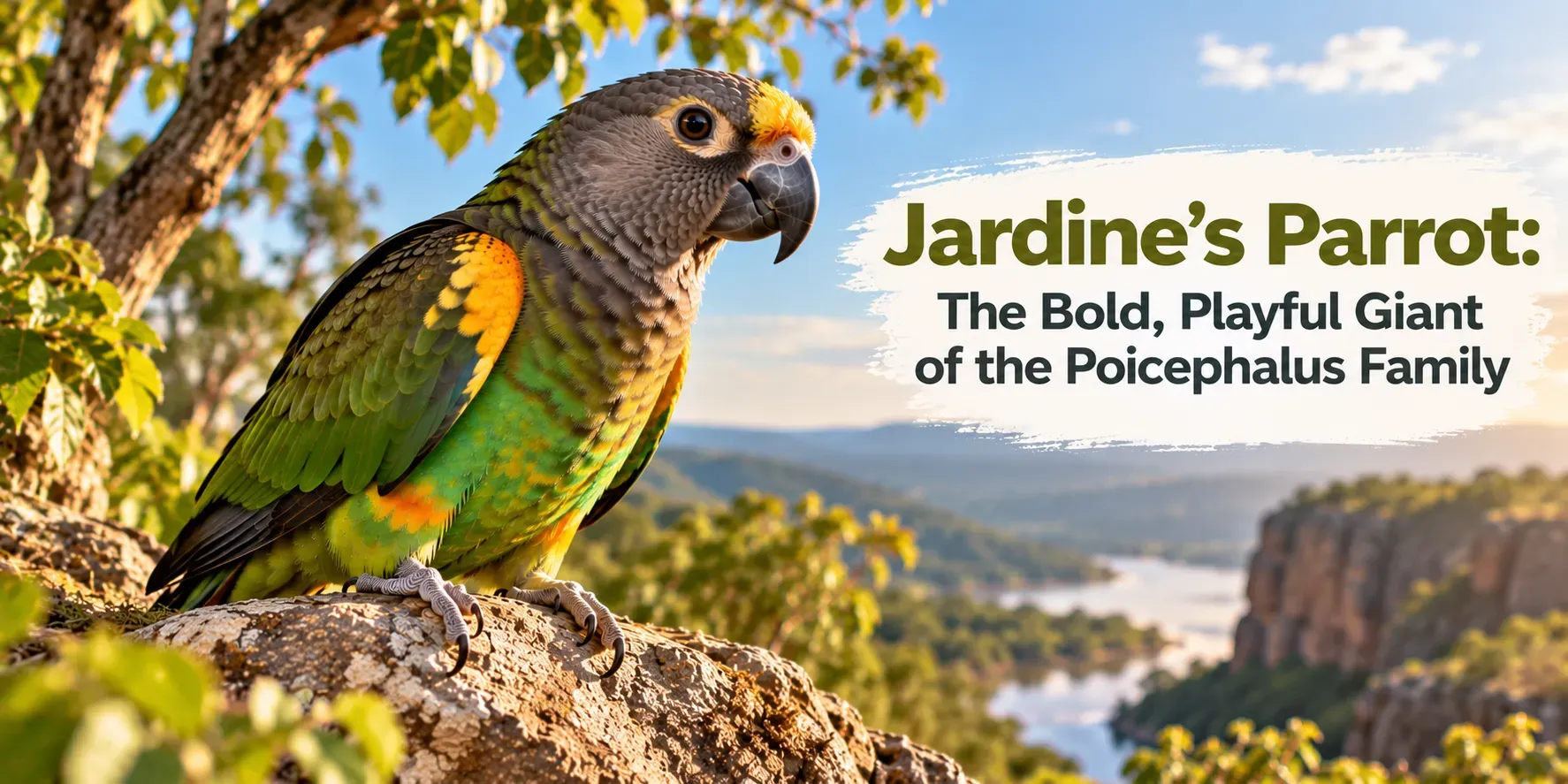
Among the Poicephalus parrots, the Jardine’s stands out for sheer presence. It is the largest member of the group, with dark green plumage splashed with orange red at the forehead, shoulders and thighs, and a personality that is bold, curious and endlessly active. Many owners call it the hidden gem of the medium parrot world, a bird with the energy of a conure, the brains of a larger parrot and a volume that most households can live with. This guide covers everything you need to decide whether a Jardine’s is right for you.
What is a Jardine’s Parrot?
The Jardine’s Parrot (Poicephalus gulielmi), also called the Red Fronted Parrot in some regions, is native to the forests of central and western Africa. It belongs to the same genus as the Senegal, Meyer’s, Brown Headed and Red Bellied Parrots, and it shares the compact, stocky build and calm reputation of the family. For a look at the cousins, see our guides to the Senegal Parrot, Meyer’s Parrot and Brown Headed Parrot.
What does a Jardine’s Parrot look like?
-
Length: about 11 inches
-
Weight: roughly 250 to 300 grams
-
Body: dark green
-
Forehead and crown: bright orange red at the front of the head
-
Shoulders and thighs: orange red accents
-
Beak: dark and strong
Males and females look alike, so DNA sexing is the only way to know a bird’s sex.
Personality and temperament
Jardine’s Parrots are famously bold and energetic. They are playful acrobats that love to climb, swing and explore, and they are very curious about anything new. A hand raised Jardine’s bonds closely with its person and can be very affectionate, though it is rarely a lap bird that wants to be held all day. It prefers to be involved, riding on a shoulder, playing games and investigating whatever you are doing. Like all Poicephalus, it can become a little nippy or bossy during hormonal periods, so consistent handling and clear routines help.
Are Jardine’s Parrots loud?
Jardine’s Parrots are quieter than most parrots their size. Their voice is moderate and mostly made up of whistles, chatter and short calls, rather than sustained screaming. They are not silent and will make noise when excited or seeking attention, but many keepers find them manageable in a house with understanding neighbors. For a fuller sense of how quieter small parrots compare, see our Green Cheek Conure noise level breakdown.
Do Jardine’s Parrots talk?
Many Jardine’s Parrots learn a modest vocabulary and are good at picking up whistles and household sounds. They are not ranked among the best talkers, so enjoy any speech as a bonus. Males are often said to talk a little more than females, though individual birds vary.
How much does a Jardine’s Parrot cost?
Hand raised Jardine’s Parrots cost $900 to $1,800 in the US in 2026. They sit at the top of the Poicephalus price range because of their larger size and fewer breeders.
| Poicephalus Species | Length | Price 2026 |
|---|---|---|
| Senegal Parrot | 9 inches | $500 to $1,000 |
| Meyer’s Parrot | 9 inches | $550 to $1,100 |
| Red Bellied Parrot | 9 inches | $650 to $1,300 |
| Brown Headed Parrot | 9 inches | $700 to $1,400 |
| Jardine’s Parrot | 11 inches | $900 to $1,800 |
Jardine’s Parrot vs Senegal Parrot
The Senegal is the best known Poicephalus and the usual comparison. The Senegal is smaller, costs less and has a grey head with a yellow to orange belly. The Jardine’s is larger and bolder, with orange red markings and a more athletic, high energy personality. If you want a calm, compact companion, the Senegal is a safe pick. If you want more size and spark, the Jardine’s is the better match.
Care requirements
Cage. At least 30 by 24 by 36 inches, with bar spacing of no more than three quarters of an inch. Jardine’s are strong chewers, so choose a sturdy cage.
Diet. About 60 to 70 percent quality pellet, 20 to 30 percent fresh vegetables and limited fruit, with nuts as treats.
Out of cage time. At least 3 hours daily. This is an active parrot that needs real exercise.
Enrichment. Rotate foraging toys, chewable wood and climbing ropes every week.
Sleep. 10 to 12 hours of dark, quiet sleep.
Enrichment and training ideas
A Jardine’s will invent its own entertainment if you do not provide any, so give it good options. Foraging boxes, puzzle feeders and paper wrapped treats keep the mind busy. Training is a great outlet: step up, recall and simple tricks such as turning around or waving are easy to teach with a favorite nut as a reward. Daily bathing or misting is also popular. A bird that has both mental work and physical exercise is usually calmer and quieter.
Common mistakes with Jardine’s Parrots
-
Too little out of cage time. A cooped up Jardine’s becomes noisy and nippy.
-
A seed heavy diet. Seeds are tasty but unbalanced, and a pellet based diet supports better health.
-
Overhandling during hormones. Petting under the wings and on the back can encourage hormonal behavior, so keep contact to the head and neck.
-
Skipping the avian vet. An annual wellness exam catches problems early.
A day in the life of a Jardine’s Parrot
A healthy Jardine’s has a lively daily rhythm. It wakes at sunrise, often with a burst of whistles, then eats breakfast while watching the household. Out of cage time is the highlight of the day, with climbing, chewing, training and shoulder rides. Afternoons call for a nap, a bath or a foraging toy. Evenings are for calm company, then a covered cage and a full night of sleep. Birds that keep this kind of steady routine are calmer, quieter and less likely to develop bad habits.
Is a Jardine’s Parrot good with children and other pets?
A well socialized Jardine’s can be a fun family bird, but its beak is strong and its energy is high, so children should always handle it under supervision and learn to read the bird’s body language. Jardine’s Parrots should never be allowed to roam freely with dogs, cats or other birds, because even a friendly encounter can end in injury. Keep interactions with other pets separate and supervised.
Health and vet care
Weigh your Jardine’s weekly on a gram scale, keep the cage clean, and avoid aerosols, non stick cookware fumes and scented candles, which can harm a parrot’s respiratory system. Schedule an annual wellness exam with an avian vet even when the bird looks perfectly healthy, because parrots hide illness until it is advanced. Learn the early signs in our guide to the warning signs your parrot is sick.
Questions to ask when you inquire
-
Is the bird fully weaned and eating pellets, vegetables and a variety of foods?
-
Has the bird been DNA sexed and disease tested?
-
How has the bird been handled and socialized so far?
-
Can you see recent photos and video of the exact bird?
-
What diet is it eating now, so you can keep it consistent at home?
How long do Jardine’s Parrots live?
Roughly 30 to 40 years with good care. Compare it with every other species in our parrot lifespan chart.
Is a Jardine’s Parrot right for you?
Choose one if you want an energetic, affectionate, quieter than average parrot with real personality and you can offer several hours of daily time.
Choose a different species if you want a strong talker or a quiet lap bird.
Where to buy a Jardine’s Parrot
See the Jardine’s Parrot product page and the Red Bellied Parrot product page for the Poicephalus parrots currently listed, browse the other parrots category, check the new born babies page, or contact Mo directly for availability. Buyers in Southern California can visit the aviary, and Texas buyers can have a bird shipped safely via Delta Cargo.
Frequently asked questions
How much does a Jardine’s Parrot cost?
A hand raised Jardine’s Parrot costs $900 to $1,800 in the US in 2026.
How big is a Jardine’s Parrot?
About 11 inches long, which makes it the largest of the Poicephalus parrots.
Are Jardine’s Parrots loud?
They are quieter than most parrots their size, with a moderate voice, but they are not silent and can be vocal when excited.
Do Jardine’s Parrots talk?
Many learn a modest vocabulary of words and phrases, though they are not top talkers.
What is the difference between a Jardine’s and a Senegal?
Jardine’s is larger, more brightly marked with orange red on the head, shoulders and thighs, and usually more expensive. Senegals are smaller and have a grey head with a yellow to orange belly.
How long do Jardine’s Parrots live?
Roughly 30 to 40 years with good care.