Macaw Colors Explained: Best 2026 Species Guide
Updated November 5, 2026
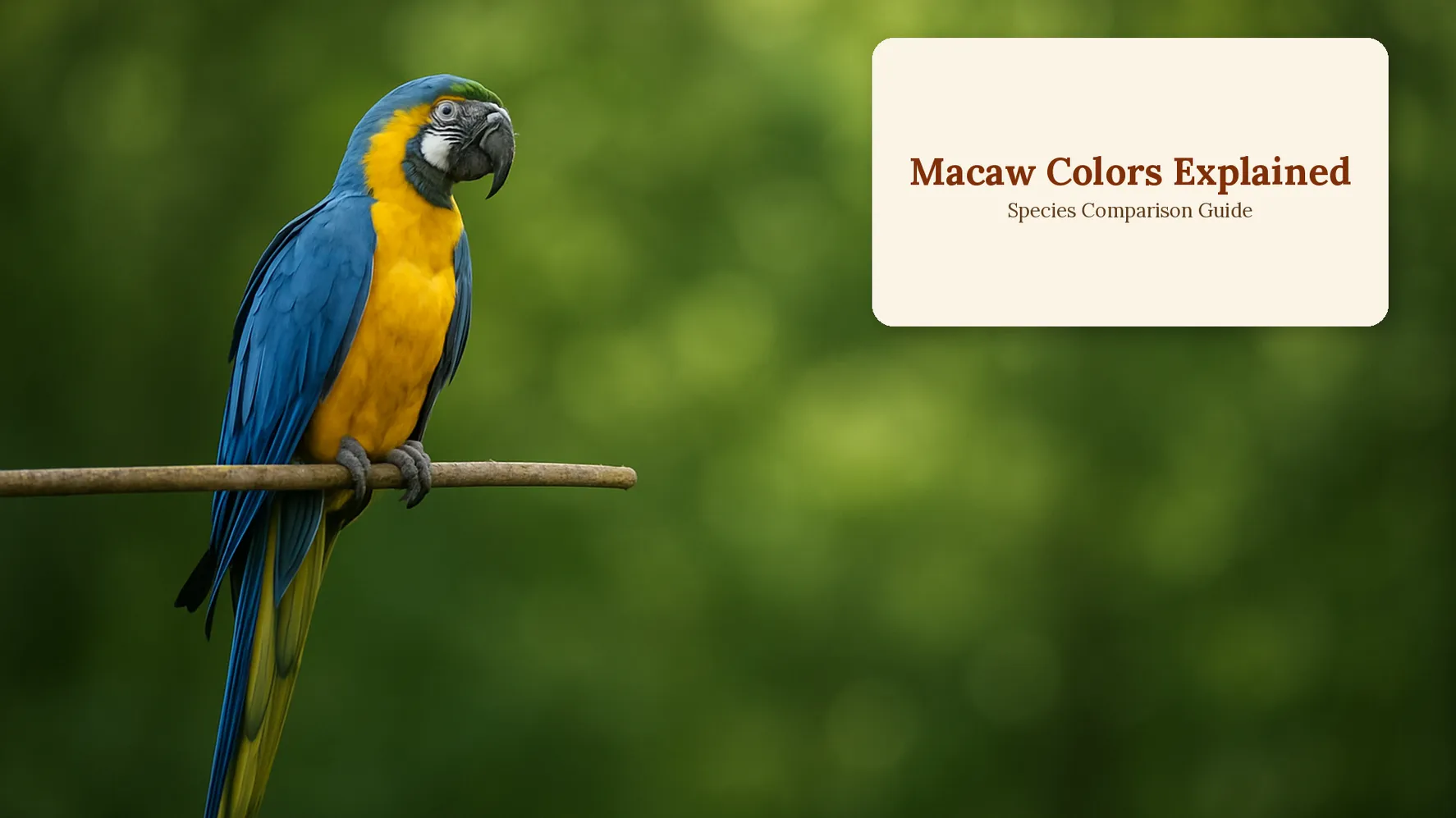
Macaw colors are the fastest way to tell these dramatic parrots apart, and they vary far more than most first-time buyers expect. Beyond the familiar blue-and-yellow bird from cartoons, macaw colors range from cobalt blue and deep maroon to olive green and the swirling, one-of-a-kind patterns of hybrid birds.
Table of Contents
This guide breaks down every major macaw color group by species, shows you how to tell visually similar birds apart, and compares size, temperament, and price so you can match the right macaw colors to your home and experience level.
Macaw Colors at a Glance
Before diving into each species, here’s a quick overview of the main macaw color families you’ll encounter at breeders and in the pet trade. Each group shares a dominant plumage tone, though individual birds vary slightly.
| Color Group | Example Species | Native Range |
|---|---|---|
| Blue & Gold | Blue and Gold Macaw | South America (Amazon Basin) |
| Solid Blue | Hyacinth Macaw | Central/Eastern Brazil |
| Scarlet Red | Scarlet Macaw | Central & South America |
| Deep Maroon-Red | Green-Winged Macaw | South America |
| Olive Green | Military Macaw | Mexico to South America |
| Bright Green | Severe & Hahn’s Macaw | Central/South America |
| Mixed/Hybrid | Catalina, Harlequin, Camelot | Captive-bred only |
Blue Macaws: The Blue Color Group
True blue plumage is rarer in nature among macaws than green, which is part of why blue birds command such strong demand. Two species dominate this group.
The Blue and Gold Macaw pairs a cobalt-blue back, wings, and tail with a golden-yellow chest and belly. Its face is white and featherless, marked with thin black feather lines, and it wears a green forehead patch and black chin. This is the macaw color pattern most people picture first.
The Hyacinth Macaw is a different blue entirely: an even, deep cobalt-blue across its whole body, broken only by a ring of bright yellow bare skin around the eye and at the base of the lower beak. As the largest parrot species in the world, its size alone sets it apart from every other blue macaw.
A handful of rarer blue-plumaged macaws exist too, including the Lear’s Macaw (closely related to the Hyacinth but smaller) and the critically endangered Spix’s Macaw, both tightly protected under CITES and essentially unavailable in the US pet trade. For a full price breakdown across every blue variety, see our blue macaw price guide.
Red Macaws: Scarlet vs. Green-Winged
Red is the other classic macaw color, but two species get confused constantly because both look “mostly red” at a glance.
The Scarlet Macaw is bright, fire-engine red across the body, head, and tail, with a wing panel that transitions from yellow to blue. Its face is bare white skin with no feather lines at all, and its beak is two-toned: pale horn-colored on top, black on the bottom.
The Green-Winged Macaw (also called the Red-and-Green Macaw) is a deeper, maroon-leaning red, and its wing panel shows green instead of yellow before fading to blue. Its white facial skin is lined with thin rows of tiny red feathers, and its beak is almost entirely dark. It’s also noticeably larger than the Scarlet.
-
Wing color: yellow-to-blue signals a Scarlet Macaw; green-to-blue signals a Green-Winged Macaw.
-
Face markings: bare white skin with no lines means Scarlet; thin red feather lines mean Green-Winged.
-
Beak color: a pale upper beak points to Scarlet; an all-dark beak points to Green-Winged.
-
Body tone: bright red leans Scarlet; deeper maroon-red leans Green-Winged.
Green Macaws: Military, Great Green, and Severe
Olive and bright green plumage belongs to a wider range of macaw species, from large to miniature.
The Military Macaw is olive-green overall with a red forehead patch, blue flight feathers, and a blue-tipped tail — named for its resemblance to a military uniform. The closely related Great Green (Buffon’s) Macaw shares the same olive-green and red-forehead pattern but is noticeably larger and rarer in the pet trade.
The Severe Macaw is a mini macaw: bright green with a distinctive maroon-brown forehead patch and hints of blue on the crown, at roughly 18 inches long.
Mini Macaw Colors: Hahn’s and Severe
Not every macaw is 30+ inches long. Mini macaw colors tend to run green-dominant, but each species still has its own signature markings worth knowing before you buy.
The Hahn’s Macaw is the smallest macaw species at roughly 12 inches, mostly bright green with a subtle blue-green tint across the crown and forehead, and yellow-green underwing coverts that flash when it stretches its wings. For a side-by-side look at every mini macaw, check our smallest macaw species comparison.
Hybrid Macaw Colors: Catalina, Harlequin, and Camelot
Captive breeding has produced a separate category of macaw colors that never occur in the wild: planned hybrids that blend two parent species’ plumage into something new. Each bird is genuinely one of a kind, since hybrid coloring varies by individual even within the same cross.
-
Catalina Macaw — a Scarlet × Blue and Gold cross, typically showing an orange-to-red chest fading into blue-green wings and back.
-
Harlequin Macaw — a Blue and Gold × Green-Winged cross, usually a patchwork of green, blue, and red across the body.
-
Camelot Macaw — a Catalina × Green-Winged cross, generally larger and deeper red-orange than a Catalina, with strong blue wing coloring.
-
Calico Macaw — a three-way blend of Scarlet, Blue and Gold, and Military bloodlines, producing some of the most varied plumage of any hybrid.
Because hybrid plumage depends on which parent traits each chick inherits, no two birds — even from the same clutch — look identical. See our macaws for sale guide for what to check before buying a hybrid.
Macaw Species Comparison Table
Color is only part of the decision. Size, noise level, and experience needed all shift significantly between macaw species, and so does price.
| Species | Primary Color | Length | Experience Level |
|---|---|---|---|
| Hahn’s Macaw | Green | ~12 in | First-time macaw owners |
| Severe Macaw | Green | ~18 in | Some parrot experience |
| Blue and Gold Macaw | Blue & Gold | ~34 in | Experienced owners |
| Military Macaw | Olive Green | ~27 in | Experienced owners |
| Scarlet Macaw | Red | ~33 in | Very experienced owners |
| Green-Winged Macaw | Maroon-Red | ~36 in | Very experienced owners |
| Hyacinth Macaw | Blue | ~40 in | Very experienced owners |
For a detailed, species-by-species price breakdown, see our complete macaw cost guide.
Do Male and Female Macaws Have Different Colors?
Unlike the Eclectus Parrot, where males and females look dramatically different, nearly all macaw colors are identical between the sexes. A male and female Blue and Gold Macaw, for example, are visually indistinguishable without DNA or surgical sexing.
A few subtle exceptions exist — some breeders report slightly duller tones in young hens of certain species — but none are reliable enough to sex a macaw by plumage alone. If you need to know a bird’s sex for breeding or pairing purposes, a DNA test from a feather or blood sample is the only dependable method.
Choosing a Macaw by Color
It’s tempting to pick a macaw purely on how striking its colors are, but color alone doesn’t tell you about noise level, lifespan, or the daily commitment a macaw requires. Use the color groups above to narrow down which species catch your eye, then weigh that choice against the factors below before deciding.
-
Space: solid-blue and deep-red species tend to be the largest macaws, which need the most cage and flight room.
-
Noise level: green mini macaws (Hahn’s, Severe) are generally quieter than full-size blue or red macaws.
-
Experience: hybrid macaws often come from large parent species and carry the same experience requirements as a Scarlet or Green-Winged Macaw.
-
Lifespan: macaws, regardless of color or species, come with a multi-decade commitment of 30 to 60+ years.
Frequently Asked Questions About Macaw Colors
What is the most colorful macaw species?
Hybrid macaw colors like the Catalina and Harlequin Macaw tend to be the most visually striking, since they blend plumage from two or three parent species into a single bird.
Are there white macaws?
No macaw species is naturally white. White-looking parrots, like cockatoos, belong to an entirely different family, though some macaws do have bare white facial skin.
Can a macaw’s colors change as it ages?
Yes, to a degree. Young macaws often show duller or darker plumage and eye color that brightens and matures over their first one to three years.
What’s the rarest macaw color?
The deep, even blue of the Spix’s Macaw is effectively the rarest macaw color alive, with the species listed as critically endangered according to the IUCN and essentially unavailable outside conservation programs.
Do macaw colors indicate personality?
Not directly. Personality in macaws tracks more closely with species, individual upbringing, and socialization than with plumage color, so two differently colored macaws of the same species usually behave more alike than two same-colored macaws of different species.
Whatever macaw colors catch your eye, matching the species to your experience level and home matters more than the pattern alone. Every bird above is hand-raised and DNA-tested before it goes home with a new family, so you always know exactly what species and lineage you’re getting. Browse our current hand-raised macaws at Morphnests to see available colors and species in person.